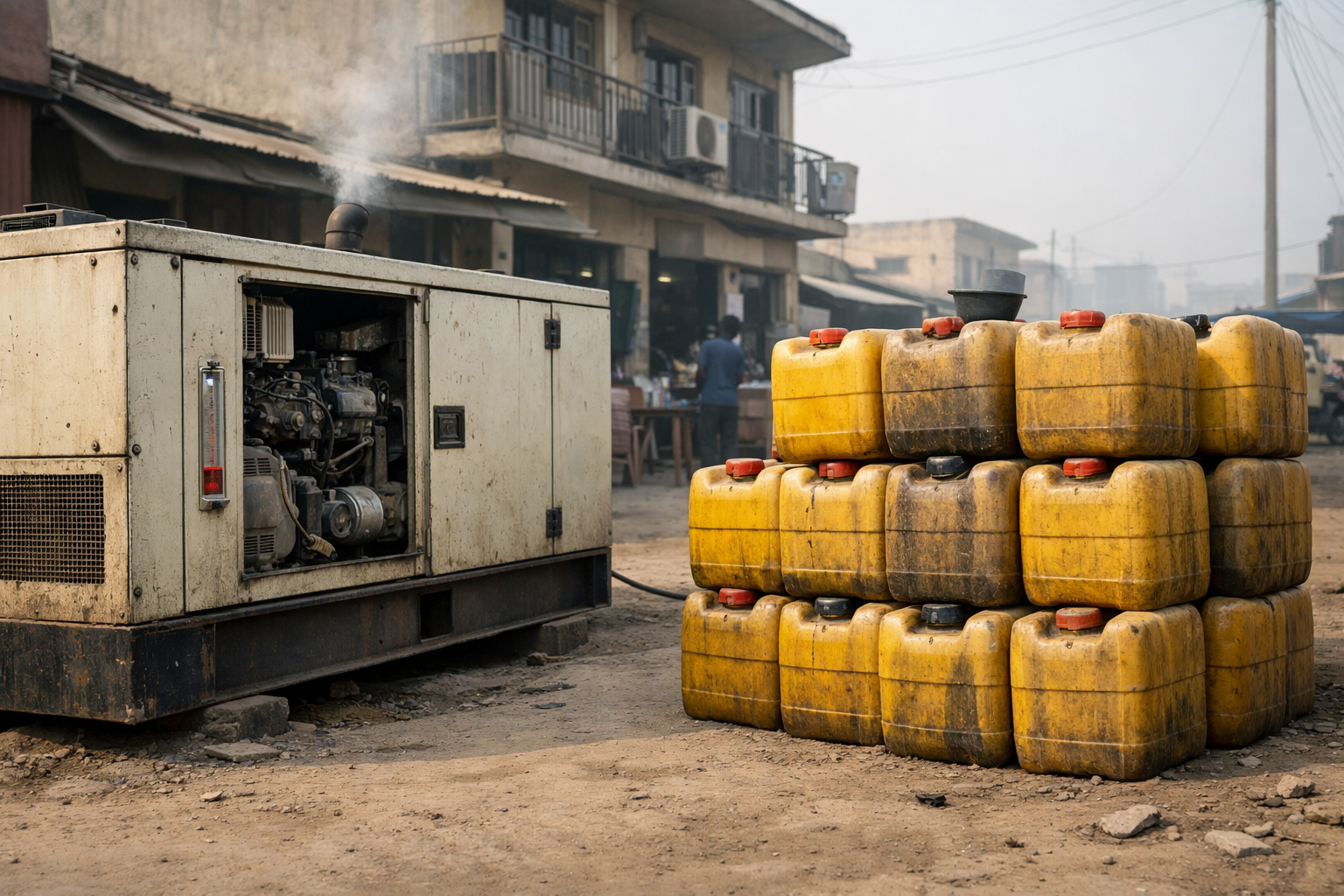
In Nigeria today, diesel generators are no longer emergency equipment.
For many businesses, they have become daily workhorses.
Offices power through meetings, schools run classes, clinics protect patients, and supermarkets preserve stock — all on diesel.
This shift has made generator fuel consumption in Nigeria one of the most underestimated drivers of business operating costs.
What most businesses track is the diesel price.
What they rarely track is how much fuel is actually being burned. A generator consuming just a few litres per hour can quietly burn hundreds — even thousands — of litres each month when run daily.
In a country where grid power remains inconsistent and outages can last hours, generators routinely run far beyond the “backup” role they were designed for.
The result is fuel consumption that feels normal day to day, but becomes alarming when viewed monthly or annually.
This article breaks down generator fuel consumption in practical terms: how it’s measured, how much different generators and business types typically consume, and why fuel usage often matters more than diesel price alone.
The goal is not to criticise generator use — it’s to help Nigerian businesses see the full picture.
Once fuel consumption is understood clearly, better decisions around cost control, efficiency, and long-term power strategy become much easier to make.
Why Generator Fuel Consumption Is So High in Nigeria
Generator fuel consumption in Nigeria is unusually high, not because generators are inefficient by default, but because of how they are used in local conditions.
In most countries, generators are designed to serve as temporary backup systems.
In Nigeria, they often function as primary power sources — and that single difference changes everything.
The first driver is grid unreliability. Frequent outages, unstable voltage, and unscheduled power cuts force businesses to run generators for long, continuous hours.
In many parts of the country, it’s normal for a generator to run 4–16 hours daily, sometimes longer.
Fuel consumption compounds quickly when machines operate far beyond backup duty.
The second factor is load behaviour. Nigerian businesses rarely run generators at steady, optimised loads.
Power demand fluctuates throughout the day — air conditioners switching on, pumps starting, freezers cycling, office equipment ramping up.
These load spikes increase fuel burn, especially when generators are not properly sized for real-world usage.
Heat also plays a major role. Nigeria’s ambient temperatures put additional strain on engines.
Higher temperatures reduce combustion efficiency and increase cooling demand, both of which push fuel consumption upward.
Generators running in poorly ventilated enclosures or congested urban environments burn even more diesel to maintain output.
Another critical issue is generator oversizing or undersizing. Many businesses purchase generators based on rough estimates or future hopes rather than actual load analysis.
An oversized generator running far below optimal load wastes fuel. An undersized one, constantly overstressed, burns fuel inefficiently and wears out faster.
Both scenarios increase diesel consumption unnecessarily.
Maintenance culture further compounds the problem.
Clogged filters, worn injectors, old oil, and poorly tuned engines all reduce fuel efficiency.
When generators run daily, even small maintenance lapses translate into significant extra fuel burn over time.
Finally, there’s the structural reality: Nigerian businesses often rely on diesel as a reliability insurance policy.
Downtime feels riskier than fuel waste. As a result, generators are left running continuously “just in case,” even during partial grid availability.
This defensive operating mindset pushes fuel consumption higher than it needs to be.
In short, high generator fuel consumption in Nigeria is not caused by one single issue.
It’s the result of long operating hours, fluctuating loads, heat, sizing mistakes, maintenance gaps, and a power environment that forces generators to do a job they were never meant to handle full-time.
How Generator Fuel Consumption Is Measured
To understand generator fuel consumption in Nigeria, it’s important to know how consumption is actually calculated.
Many misunderstandings come from assuming generators burn a fixed amount of diesel at all times.
In reality, fuel consumption depends on a few measurable variables working together.
Fuel Consumption Is Measured in Litres per Hour
The most basic unit used is litres per hour (L/hr). This simply means how much diesel a generator consumes while running for one hour.
However, this figure is never absolute. A generator does not consume the same amount of fuel at idle, half load, or full load.
That’s why manufacturers usually provide fuel consumption figures at different load levels.
For example:
- At low load → lower litres per hour
- At higher load → higher litres per hour
In Nigerian business settings, generators rarely operate at a steady load, which is why real-world consumption often exceeds expectations.
Load Percentage Is the Most Important Factor
Generator fuel consumption is directly tied to load percentage, not just generator size.
Load percentage refers to how much of the generator’s rated capacity is being used at a given time:
- 25% load
- 50% load
- 75% load
- 100% load
Most diesel generators are most fuel-efficient between 60–80% load.
Below this range, fuel is wasted. Above it, the engine is stressed and burns diesel inefficiently.
In Nigeria, many generators run:
- Far below optimal load (oversized generators)
- Or constantly above safe load (undersized generators)
Both situations increase fuel consumption unnecessarily.
Generator Size Does Not Equal Fuel Efficiency
A common mistake is assuming a bigger generator automatically means higher fuel consumption.
Size alone does not determine how much diesel is burned — load does.
A 100 kVA generator running at 30% load can consume more fuel per useful unit of power than a 40 kVA generator running at 70% load.
This is why proper generator sizing matters more than raw capacity.
In practice, many Nigerian businesses choose generators based on availability or future expansion hopes, not current load data. That decision directly affects fuel efficiency.
Runtime Multiplies Consumption
Fuel consumption figures are hourly, but cost is cumulative.
If a generator consumes 5 litres per hour:
- 8 hours per day = 40 litres daily
- 30 days = 1,200 litres monthly
In Nigeria, where generators often run daily due to grid instability, runtime is just as important as litres per hour. Even “efficient” generators become expensive when operating for long hours.
Environmental and Operating Conditions Matter
Real-world fuel consumption is also influenced by:
- Ambient temperature (higher heat increases fuel burn)
- Altitude and ventilation quality
- Fuel quality
- Maintenance condition (filters, injectors, oil)
Manufacturer fuel charts are usually based on ideal conditions, not the hot, dusty, stop-start reality most Nigerian generators operate in. This explains why actual consumption is often higher than expected.
Average Generator Fuel Consumption by Generator Size
One of the most common questions Nigerian businesses ask is: “How much diesel does my generator actually consume?”
The answer depends largely on generator size and load, not guesswork or brand reputation.
Below are realistic fuel consumption ranges based on typical diesel generators operating under Nigerian business conditions. These figures are not exact guarantees — they reflect practical averages, not manufacturer’s ideal scenarios.
Small Generators (5–10 kVA)
These generators are commonly used by:
- Small offices
- Shops and pharmacies
- Apartments and small clinics
Average fuel consumption:
- 1.0 – 2.5 litres per hour, depending on load
At moderate use (6–8 hours daily), monthly consumption can reach 180–600 litres, especially when air conditioners or refrigerators are involved.
A common issue in Nigeria is running small generators close to full load for long hours, which increases fuel burn and accelerates wear.
Medium Generators (15–30 kVA)
This is the most common category for:
- Schools
- Mid-sized offices
- Clinics
- Supermarkets
Average fuel consumption:
- 3 – 6 litres per hour at normal operating load
When run for 8–12 hours daily — which is typical in many Nigerian cities — monthly diesel usage often falls between 700 and 1,800 litres.
Many businesses underestimate this range because they only consider fuel purchases weekly, not cumulatively.
Large Commercial Generators (40–100 kVA)
Used by:
- Hospitals
- Hotels
- Large schools
- Manufacturing and processing facilities
Average fuel consumption:
- 7 – 15 litres per hour, depending on load and efficiency
At long runtimes, monthly diesel consumption can exceed 2,000–4,000 litres easily. At this scale, fuel becomes one of the largest operational expenses after staffing.
Poor load management in this category leads to massive fuel waste.
Very Large / Industrial Generators (150 kVA and Above)
Typically used by:
- Large factories
- Data centers
- Industrial estates
Average fuel consumption:
- 20 litres per hour and above, scaling with load
These systems are extremely expensive to run continuously and are rarely intended for daily full-time use. In Nigeria, however, grid unreliability forces many facilities into exactly that situation.
Why These Numbers Often Surprise Business Owners
Two reasons stand out:
- Generators rarely run at optimal load
Oversized generators burn more fuel per unit of useful power than expected. - Hours multiply quietly
Even a “modest” 4 litres per hour becomes over 1,000 litres per month when run daily.
Businesses often focus on generator size but ignore runtime and load behaviour, which matter just as much.
Important Context
Manufacturer brochures often list fuel consumption under ideal laboratory conditions:
- Stable load
- Clean fuel
- Moderate temperature
Nigerian conditions — heat, dust, voltage fluctuations, and long runtimes — usually push real consumption higher than brochure figures.
Common Misunderstandings About Generator Efficiency
Generator efficiency is one of the most misunderstood topics in Nigeria’s power landscape.
Many businesses believe they are running “efficiently” simply because the generator starts reliably or consumes less fuel than expected on certain days.
In reality, several widely held assumptions quietly lead to higher fuel consumption and operating costs.
Let’s clear up the most common misconceptions.
“A Bigger Generator Is Always Better”
This is one of the costliest misunderstandings.
Many businesses buy oversized generators to “be safe” or to prepare for future expansion.
While this feels prudent, oversized generators often run at very low load, where diesel engines are least efficient.
Fuel is burned just to keep the engine running, even when actual power demand is modest.
The result: higher fuel consumption per useful unit of electricity.
Efficiency comes from proper sizing, not excess capacity.
“If the Generator Is On, We Might as Well Leave It Running”
In Nigeria, it’s common to leave generators running continuously to avoid frequent restarts or sudden outages.
This habit feels convenient, but it’s inefficient.
Generators burn fuel even at idle or low load.
Leaving them on during periods of reduced demand — lunch breaks, slow hours, partial grid return — adds unnecessary runtime that compounds fuel usage over days and weeks.
Convenience-driven runtime is one of the quietest fuel wasters.
“New Generators Are Automatically Fuel-Efficient”
Newer generators are generally more efficient than older ones, but only under the right conditions.
If a new generator is:
- Poorly sized
- Poorly maintained
- Run at the wrong load range
- Operated for excessive hours
Its efficiency advantage disappears quickly.
Nigerian conditions — heat, dust, voltage instability — can also erode expected performance if not properly managed.
Efficiency depends on how a generator is used, not just how new it is.
“Lower Fuel Consumption One Day Means the System Is Efficient”
Fuel usage can vary daily based on load, weather, and runtime.
A low-consumption day does not mean a generator is efficient overall.
What matters is average consumption over time:
- Weekly
- Monthly
- Annually
Many businesses feel relieved on “good days” and ignore patterns that show steadily rising fuel use across longer periods.
Efficiency is a trend, not a single data point.
“Maintenance Is About Preventing Breakdowns, Not Saving Fuel”
Maintenance is often seen as a reliability issue, not a fuel-efficiency issue. This is a mistake.
Dirty filters, worn injectors, old oil, and poor tuning all increase fuel burn.
In Nigeria’s operating environment, even small maintenance lapses can reduce efficiency significantly.
Well-maintained generators don’t just break down less — they consume less fuel doing the same work.
“Fuel Efficiency Is Mostly About Diesel Quality”
Fuel quality matters, but it’s not the dominant factor many believe it is.
Even with good diesel, a poorly sized or poorly managed generator will burn excess fuel.
Conversely, a well-sized, well-maintained generator with average fuel quality can outperform expectations.
Fuel efficiency is primarily a system issue, not a fuel sourcing issue.
The Real Lesson
Generator efficiency is not about a single decision or component. It’s about alignment:
- Right size
- Right load
- Right runtime
- Right maintenance
When these elements are misaligned, fuel consumption rises quietly and persistently.
Clearing up these misunderstandings helps businesses move from reacting to fuel costs toward managing energy strategically.
Conclusion
Generator fuel consumption in Nigeria is no longer a background issue — it is a core business cost that shapes cash flow, planning, and long-term resilience.
For many businesses, generators now run daily for extended hours, quietly consuming thousands of litres of diesel each year.
When this usage is multiplied by today’s volatile diesel prices, fuel stops being a minor inconvenience and becomes a structural financial burden.
What this article has shown is that fuel consumption matters more than most businesses realise.
Generator size, load behaviour, runtime, heat, and maintenance all influence how much diesel is burned.
Two businesses paying the same price per litre can end up with vastly different energy costs simply because one consumes far more fuel than the other.
In Nigeria’s power environment, where grid reliability cannot be guaranteed, this distinction is critical.
Understanding fuel consumption changes how decisions are made. Instead of reacting to price increases, businesses begin to look at hours run, litres burned, and total annual exposure.
For many, this is the moment when diesel stops being treated as an unavoidable cost and starts being evaluated as a strategic risk.
High fuel consumption is often the clearest signal that generators are being pushed beyond their intended role.
At that point, the conversation naturally expands — from managing diesel purchases to improving efficiency, reducing runtime, and reconsidering the overall power strategy.
Nigerian businesses that take this broader view are better positioned to control costs, protect operations, and plan with confidence, even in an unpredictable power landscape.
In the end, generators will remain part of Nigeria’s energy reality for the foreseeable future.
But understanding and managing fuel consumption is what separates businesses that merely cope from those that operate with clarity, stability, and long-term control.