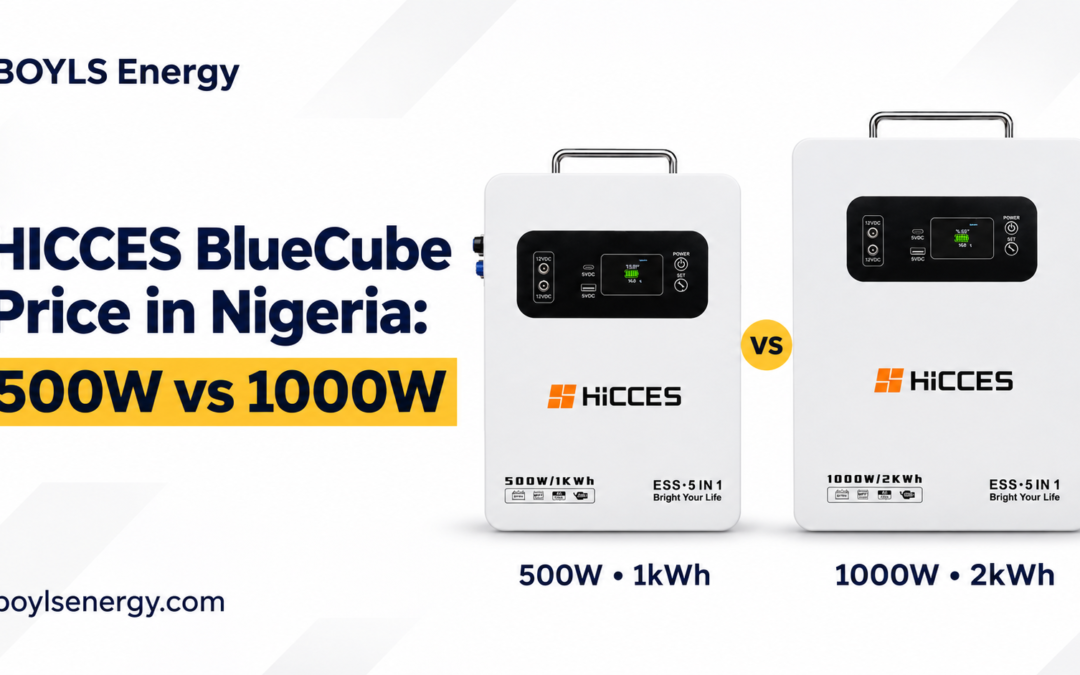
A fully charged HICCES BlueCube 500W/1kWh could run a TV, standing fan, refrigerator, and Wi-Fi router together for about 3 hours 40 minutes.
The HICCES BlueCube 1kW/2kWh could run the same appliances for about 7 hours 15 minutes. These estimates assume the four appliances draw 220 watts on average and that the BlueCube can handle the refrigerator’s startup demand.
For a household in Nigeria choosing between the two, that gives a practical starting point. If the power goes off at 6 pm and you want all four appliances until 10 pm, the smaller BlueCube would fall about 20 minutes short.
If you only need the TV, fan and router, the smaller unit could give you about five hours. Whether the fridge needs to stay on could change your purchase decision by ₦300,000.
HICCES BlueCube runtime by appliance combination
The table uses a 100W TV, a 50W standing fan and a 10W Wi-Fi router. For the refrigerator, we assume a compressor that draws 120W while cooling and runs for half the time, averaging 60W over the outage. Your appliances may draw more or less.
| Appliances running together | Average power in this example | BlueCube 500W/1kWh | BlueCube 1kW/2kWh |
|---|---|---|---|
| TV and Wi-Fi router | 110W | About 7 hr 15 min | About 14 hr 35 min |
| TV, fan and Wi-Fi router | 160W | About 5 hr | About 10 hr |
| Fan, refrigerator and Wi-Fi router | 120W | About 6 hr 40 min | About 13 hr 20 min |
| TV, fan, refrigerator and Wi-Fi router | 220W | About 3 hr 40 min | About 7 hr 15 min |
| All four appliances plus two 10W LED lights | 240W | About 3 hr 20 min | About 6 hr 40 min |
These are calculated estimates, rounded to the nearest five minutes.
They assume a full battery, no charging during the outage, and 80% of nominal battery capacity available to AC appliances.
BOYLS has used 80% as a planning allowance. Actual runtime depends on the unit, the connected appliances, and how you use it.
Every row that includes a refrigerator also depends on startup compatibility.
Can a HICCES BlueCube start your refrigerator?
There are two questions to answer before buying a BlueCube for a fridge:
Can it start the compressor?
And how long can it keep the fridge running alongside everything else?
When the compressor in our example is cooling, the four appliances draw about 280W. When it switches off, the TV, fan and router continue drawing 160W.
That explains the 220W average used for runtime. At the instant the compressor starts, however, it may briefly draw more power than its normal running figure.
The supplied HICCES brochures list 500W and 1,000W rated output for the two BlueCubes.
They do not specify a verified surge rating or how long either model can sustain it.
Even though 280W falls within both continuous output ratings, that figure alone cannot establish that either unit will start a particular refrigerator.
If keeping your fridge on is the main reason you’re buying, send BOYLS its model number and a clear photo of the rating label before choosing a BlueCube.
If the label gives only normal running power, a manufacturer specification or a compatibility test may still be needed.
Why the brochure’s 15-hour fridge figure differs from the table
The HICCES 2kWh brochure gives about 15 hours for a 120W refrigerator as an individual reference example.
It lists the TV and fan separately. Once you plug in the TV, fan, and router alongside the fridge, all four draw energy from the same battery.
For a family using them together, the combined-load estimate is the more relevant starting point.
Your own refrigerator can also change the result considerably.
If the example compressor runs continuously during an outage, the combined load rises from 220W to 280W. Estimated runtime then falls to about 2 hours 50 minutes on the smaller BlueCube and 5 hours 45 minutes on the larger one.
Which BlueCube makes sense for a four-hour evening?
Choose the 500W/1kWh model for the TV, fan, and router if your appliances are close to the example ratings and four hours is your target.
Those three devices use about 640Wh in four hours, within the 800Wh planning allowance for the smaller model.
Consider the 1kW/2kWh model if the refrigerator must stay on as well. At a 220W average, four hours takes 880Wh.
That exceeds the smaller model’s planning allowance and fits within the larger unit’s estimated 1,600Wh of available AC energy. Confirm the fridge can start before making the purchase.
If you only watch TV for part of the evening, calculate the hours separately. Suppose the TV runs from 6 pm to 8 pm, while the fan, fridge, and router are needed until 10 pm.
Under the same fridge assumptions, the first two hours use 440Wh and the next two use 240Wh, for a total of 680Wh.
That fits the smaller unit’s estimated energy budget. In this household, asking “What time do you switch off the TV?” is worth doing before spending another ₦300,000.
How to estimate runtime for your own appliances
Estimated runtime in hours = battery capacity in watt-hours × 0.80 ÷ average appliance load in watts.
The 500W BlueCube stores 1,000Wh nominally.
The 1kW model stores 2,000Wh.
The watt rating tells you how much equipment the inverter can run at once.
The watt-hour figure helps you estimate how long it can run that equipment.
For the best estimate, measure the TV and fan at the settings you normally use. Include the decoder if you watch satellite TV, and include both the router and fibre box if your internet connection needs both.
For a refrigerator, use a plug-in energy meter over a representative period that includes several cooling cycles.
For example, if the meter records 1.44kWh in 24 hours, the fridge averaged 60W over that day: 1,440Wh divided by 24 hours.
You can then replace the 60W assumption in our table with your own figure. A meter reading taken over time captures the compressor switching on and off. energy.gov
HICCES BlueCube prices in Nigeria
| HICCES BlueCube model | BOYLS Energy price recorded 13 November 2026 | Solar Village advertised price checked 19 November 2026 |
|---|---|---|
| 500W/1kWh | ₦300,000 | ₦315,000 solarvillage.africa |
| 1kW/2kWh | ₦600,000 | ₦595,000 solarvillage.africa |
The BOYLS package includes the power station with its built-in battery and an AC charging cable. Both the power station and battery carry a two-year warranty. Compatible solar panels are sold separately. BOYLS delivers nationwide, with delivery quoted according to your location.
If you’re comparing the BlueCube with other portable backup options, see the BOYLS guide to all-in-one solar generators in Nigeria.
Will the ₦300,000 BlueCube cover your evening?
Send BOYLS your appliance list, the hours you need each item, and your delivery location. If you want to power a refrigerator, include its model number and a photo of the rating label.
We’ll help you check whether the smaller BlueCube fits your routine, what needs confirming for your fridge, and how much delivery will cost.
Check my appliances and confirm today’s BlueCube price on WhatsApp