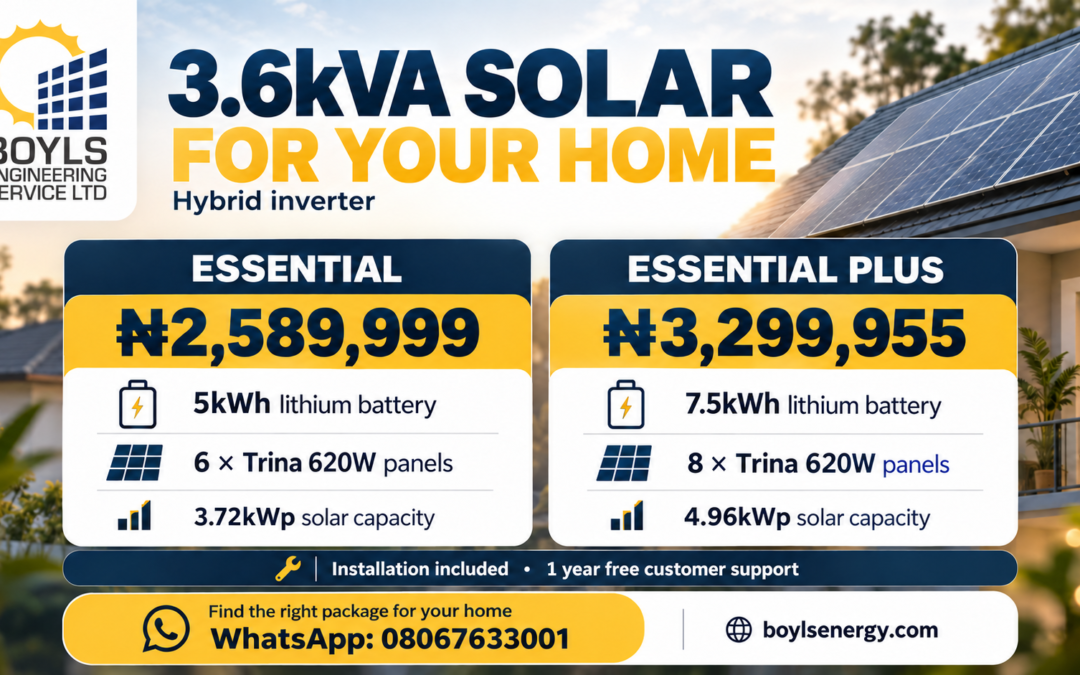

If you are considering solar for your home in Nigeria, one of your first questions will probably be:
“How much will it cost?”
It sounds simple.
But ask five solar installers for the price of a 5kVA solar system, and you may receive five completely different quotations.
One may quote ₦2.5 million.
Another may quote ₦4 million.
Another may quote ₦7 million or more.
And all three may call what they are selling a “5kVA solar system.”
So which price is correct?
Potentially, all of them.
That is because 5kVA describes the inverter capacity. It does not describe the entire solar power system.
Your actual solar installation cost depends on much more:
- How much electricity your home consumes
- How many appliances you want to run at the same time
- How many hours of backup you need
- Whether you want to run air conditioners overnight
- How much battery storage you require
- How much solar energy you need to generate
- The quality of the equipment
- Electrical protection and installation standards
So instead of asking only:
“How much is a solar system?”
A better question is:
“What does my home actually need, and what will it cost to provide that energy reliably?”
That is what this guide will help you understand.
How Much Does Solar Installation Cost in Nigeria in 2026?
Solar installation costs in Nigeria vary significantly depending on the size and energy requirements of the home.
As a general planning guide:
| Home requirement | Typical configuration | Indicative installed range |
| Essential loads | Lights, fans, TV, internet | ₦0.7m–₦1.0m |
| Small home | Essentials + limited AC use + pump | ₦1.8m–₦2.6m |
| Family home | Around 5kVA + 5–10kWh lithium storage | ₦3.6m–₦4.8m |
| Larger home | Multiple ACs + larger battery bank | ₦6m–₦9.5m+ |
| Premium/high-energy home | Several ACs, pumps + extended backup | ₦15m+ |
Important: These are indicative planning ranges, not BOYLS quotations. Your actual solar installation price will depend on your home’s energy requirements, equipment specifications, battery capacity, installation conditions, and other project-specific factors.
This is why choosing solar based only on a package price can be risky.
A ₦4 million system that properly meets your requirements may be better value than a ₦3 million system that forces you to spend another ₦2 million upgrading it six months later.
Why Two 5kVA Solar Systems Can Cost Completely Different Amounts
This is one of the most important things to understand before buying solar in Nigeria.
5kVA tells you the capacity of the inverter.
It does not tell you:
- Battery capacity
- Solar-panel capacity
- Expected backup time
- Equipment quality
- Installation quality
- Electrical protection
- Monitoring capability
- What appliances the system was designed to support
Consider two homeowners.
Homeowner A receives:
- 5kVA hybrid inverter
- 5kWh lithium battery
- Small solar array
- Basic installation
Homeowner B receives:
- 5kVA hybrid inverter
- 15kWh lithium battery
- Larger solar array
- Full electrical protection
- Professional mounting
- Energy monitoring
- Proper engineering and commissioning
Both can technically be advertised as 5kVA solar systems.
But their performance will be completely different.
Homeowner B has three times the nominal battery storage.
The solar generation may also be significantly higher.
Their expected backup periods will differ.
Their ability to support heavy loads may differ.
And naturally, their prices will differ. Pasted markdown
A simple way to understand it is:
Inverter = How much load you can run
Battery = How much stored energy you have
Solar panels = How much solar energy you can generate
You need all three to work together.
What Actually Determines Solar Installation Cost in Nigeria?
A properly designed solar system starts with the home.
Not with an inverter sitting in a warehouse.
Here are the eight major factors that determine what your system should cost.
1. Your Home’s Energy Consumption
The first question should be:
How much electricity does this home actually consume?
Consider a house with:
- 3 air conditioners
- 2 refrigerators
- Freezer
- Water pump
- TVs
- Lighting
- Fans
- Wi-Fi
- Laptops
- Washing machine
- Kitchen appliances
Simply listing these appliances isn’t enough.
We also need to know how long they operate.
A 1.5HP air conditioner running for two hours is very different from the same AC running for eight hours overnight.
The basic idea is:
Appliance Power × Operating Hours = Energy Consumption
This is why proper solar design begins with a load and energy assessment.
2. Your Peak Load Determines Your Inverter Requirement
Energy consumption tells us how much energy you use.
Peak load tells us how much electrical power you may demand at once.
Imagine that at a particular moment you have:
- Air conditioner running
- Refrigerator running
- Freezer running
- Television running
- Lights on
- Water pump starting
Your inverter must be capable of supporting the combined operating load and relevant starting demands.
But there is an important distinction:
Installing a bigger inverter does not automatically give you longer backup.
That depends largely on the amount of stored energy available from your batteries.
Think of the inverter as the width of a road and the battery as the fuel available for the journey.
A wider road does not automatically allow you to travel farther.
3. Battery Storage Can Significantly Affect the Price
Battery storage is one of the biggest cost factors in many modern residential solar installations.
A 5kVA inverter connected to a 5kWh battery is a very different energy system from the same inverter connected to 15kWh or 20kWh of storage.
The larger battery bank can potentially support your home for much longer, depending on your actual load.
So instead of asking:
“How many batteries am I getting?”
Ask:
“How many usable kilowatt-hours of battery storage am I getting?”
Battery chemistry matters too.
Different batteries have different:
- Usable depth of discharge
- Cycle life
- Charging characteristics
- Discharge capability
- Battery management systems
- Warranty conditions
Lithium iron phosphate, commonly known as LiFePO4 or LFP, has become an important option for premium residential systems because of its usable capacity, cycle life, and relatively low maintenance requirements.
But remember:
A premium battery that is too small for your energy requirement is still the wrong battery.
Correct sizing comes first.
4. Solar-Panel Capacity Determines How Much Solar Energy You Can Generate
Another common mistake is installing a large inverter and battery bank with too little solar-panel capacity.
Initially, everything may appear fine.
But after the batteries discharge, they take too long to recharge.
During poor weather or periods of heavy consumption, the homeowner increasingly depends on grid electricity or a generator to recharge them.
Then comes the frustrating question:
“I spent millions on solar. Why am I still running my generator?”
Sometimes the battery isn’t the problem.
The system simply doesn’t generate enough solar energy.
Your solar array should be designed to:
- Support daytime loads.
- Replace energy consumed from the battery.
- Account for normal system losses.
- Provide reasonable performance under actual operating conditions.
This is why you should compare solar arrays using kilowatts peak (kWp) rather than simply the number of panels.
For example:
Eight 400W panels = 3.2kWp
Eight 620W panels = 4.96kWp
Same number of panels.
Very different generation capacity.
5. Your Required Backup Time Can Change the Cost Dramatically
How long do you want your home powered when grid electricity is unavailable?
Four hours?
Six hours?
Twelve hours overnight?
Or are you trying to achieve minimal dependence on the grid and generator?
Those are different design objectives.
Suppose your average nighttime load is approximately 2kW.
Before accounting for system losses and battery operating limits:
| Backup period | Approximate energy requirement |
| 2 hours | 4kWh |
| 6 hours | 12kWh |
| 10 hours | 20kWh |
Same home.
Same appliances.
Different backup requirement.
And therefore, a very different battery requirement.
This is why saying “I need a 5kVA inverter” doesn’t tell an engineer enough.
We need to understand what you want the system to accomplish.
6. Want Your AC Running Through the Night? That Changes the Design
For many premium Nigerian homes, air conditioning is one of the biggest factors affecting solar-system size.
A house powering:
- Lights
- TV
- Refrigerator
- Wi-Fi
- Fans
has a very different energy profile from a house running three bedrooms’ air conditioners throughout the night.
Solar can power air conditioners.
But the system has to be designed for it.
There are also two very different questions:
“Can this inverter run my AC?”
and:
“Can this system run my AC from 10 pm until 6 am?”
The first is mainly a power-capacity question.
The second is largely an energy-storage question.
If your lifestyle requirement is:
“I want my family to sleep comfortably with the AC running through the night.”
Tell your solar engineer that from the beginning.
It should become part of the system design.
7. Equipment Quality Affects the Price
Two 10kWh lithium batteries are not necessarily identical.
Neither are two 5kVA hybrid inverters.
Price differences can reflect:
- Battery-cell quality
- Battery management system
- Inverter architecture
- MPPT capacity
- Surge capability
- Efficiency
- Monitoring
- Communications
- Manufacturer warranty
- Local technical support
This doesn’t mean cheaper equipment is automatically bad.
It also doesn’t mean the most expensive equipment is automatically best.
What matters is whether the equipment is:
appropriate for the application, properly specified, correctly installed and adequately supported.
8. Protection, Cabling and Installation Matter
Solar isn’t just panels, batteries and an inverter.
It is an electrical power system.
A professional installation may require:
- Correctly sized DC cables
- AC cables
- DC breakers
- AC breakers
- Surge protection
- Battery protection
- Isolators
- Earthing
- Distribution-board modifications
- Cable management
- Appropriate mounting structures
These items may not look exciting in a quotation.
But they matter.
So does skilled workmanship.
Sometimes a quotation is cheaper because important balance-of-system components have been reduced, omitted, or poorly specified.
You may not notice the consequences immediately.
The problems often appear later.
Cheap Solar vs Properly Engineered Solar
Suppose you receive two quotations.
Installer A
₦3.2 million
Installer B
₦4.5 million
Which installer offers better value?
You cannot tell from the price alone.
The ₦3.2 million system may be excellent value.
Or it may be badly undersized.
The ₦4.5 million system may be properly engineered.
Or it may simply be overpriced.
You need to understand what each system is designed to deliver.
Before choosing either quotation, ask:
- What is my calculated peak load?
- What is my estimated daily energy consumption in kWh?
- What inverter capacity are you proposing?
- How much usable battery storage is included?
- What is the solar array capacity in kWp?
- What loads can operate simultaneously?
- How many hours of backup should I realistically expect?
- Can the panels recharge the batteries while carrying daytime loads?
- What electrical protection is included?
- What warranties apply?
- What happens if something fails?
- What assumptions were used to design the system?
If these questions cannot be answered clearly, you may not yet have an engineered proposal.
You may simply have a collection of equipment with a price attached to it. Pasted markdown
The Most Expensive Solar System May Be the One You Buy Twice
Imagine spending ₦4 million on solar.
Six months later, you discover your family cannot use the air conditioners the way you expected.
So you add another battery.
Then you discover there isn’t enough solar capacity to recharge everything effectively.
You add more panels.
Later, you discover that your inverter capacity has become another limitation.
Now you’re upgrading again.
Suddenly, the system that looked cheaper at the beginning has become very expensive.
That is why proper sizing should come before equipment selection.
The goal isn’t to sell you the largest solar system possible.
It is to determine what your home actually requires and design an appropriate solution around that requirement.
What Should a Proper Residential Energy Assessment Include?
For larger residential projects—especially when you are preparing to invest several million naira—a proper assessment should go beyond counting appliances.
It should establish:
Your load profile
What electrical appliances are operating, and what are their characteristics?
Daily energy consumption
How many kilowatt-hours does the home consume?
Peak demand
What is the maximum load likely to operate simultaneously?
Nighttime demand
How much energy does the home consume when solar generation is unavailable?
Required backup period
Do you need four, six, twelve, or more hours?
Priority loads
Does everything need backup, or can certain heavy appliances be excluded?
Solar resource and roof conditions
How much usable installation space is available? Is shading a problem?
Existing electricity sources
What role will grid electricity, a generator, an existing inverter, or an existing solar system play?
These factors allow the system to be designed around your actual energy situation rather than a generic package. Pasted markdown
Do You Need to Disconnect Completely From NEPA?
Not necessarily.
For many Nigerian homes, a properly designed hybrid energy system may make more economic sense than trying to become completely off-grid.
A hybrid system can combine:
Solar + Battery + Grid + Generator
Solar can provide daytime energy.
Batteries can store energy for later use.
The grid can supplement supply when available.
And the generator can remain as emergency or supplementary backup where necessary.
The objective is not necessarily to remove every other energy source.
It may be to reduce dependence on expensive or unreliable sources while maintaining the level of reliability your home requires.
Designing around multiple available energy sources can also reduce the amount of battery storage required compared with designing for complete off-grid autonomy.
That can significantly affect project cost. Pasted markdown
Don’t Compare Solar Cost With Generator Purchase Price Alone
When evaluating solar, don’t look only at the initial equipment price.
Consider what it currently costs to keep your home powered.
That can include:
- Grid electricity
- Generator fuel
- Generator servicing
- Repairs
- Engine oil
- Replacement parts
- Time spent obtaining fuel
- Noise
- Disruption during outages
Two similar Nigerian homes can have very different economics.
One homeowner may enjoy relatively reliable grid electricity.
Another may run a generator for several hours every day.
Their reasons for investing in solar—and the appropriate system designs—will therefore differ.
The better financial question is not:
“Is solar cheaper than buying a generator?”
It is:
“What will it cost me to reliably power this home over several years under the different energy options available to me?”
That is a much more useful comparison.
How Much Should You Budget for Solar Installation in Lagos, Abuja or Port Harcourt?
If you are searching for solar installation price in Lagos, Abuja or Port Harcourt, be careful with fixed online packages.
Nigerian homes vary enormously.
A three-bedroom apartment in Lagos may have completely different energy requirements from a five-bedroom detached house in Abuja.
Even two identical-looking houses on the same street can have very different consumption patterns.
One family may use air conditioning for only a few hours.
Another may operate several ACs throughout the night.
One home may receive relatively reliable grid supply.
Another may depend heavily on a generator.
One homeowner may want six hours of backup.
Another wants twelve.
The location matters.
But your energy behaviour inside the property matters even more.
The larger the proposed investment, the more important a site-specific assessment becomes.
A Better Way to Compare Solar Quotations
Don’t compare quotations like this:
Installer A — ₦3.5 million
Installer B — ₦4.2 million
Installer C — ₦5 million
Compare what you are actually receiving:
| Specification | Installer A | Installer B | Installer C |
| Inverter capacity | |||
| Battery capacity (kWh) | |||
| Usable battery capacity | |||
| Solar capacity (kWp) | |||
| Expected backup hours | |||
| Maximum designed load | |||
| Protection included | |||
| Monitoring | |||
| Equipment warranty | |||
| Workmanship warranty | |||
| After-sales support | |||
| Total price |
You may discover that the most expensive quotation provides considerably more capability.
Or you may discover that the lower-cost system genuinely satisfies your requirements.
Either result is useful.
The goal is informed comparison—not automatically choosing the cheapest or most expensive proposal.
Frequently Asked Questions About Solar Installation Cost in Nigeria
How much does solar installation cost in Nigeria in 2026?
The cost varies significantly according to the home’s energy requirements. Small systems designed primarily for essential loads can start below ₦1 million, while lithium-based systems for larger homes can cost several million naira. Premium homes requiring multiple air conditioners and extended battery backup may require substantially larger investments. The appropriate budget should be based on the home’s actual load and energy requirements. Pasted markdown
How much is a 5kVA solar system in Nigeria?
The source draft uses a current planning range of approximately ₦3.5 million to ₦5.5 million or more for complete 5kVA residential systems. Battery capacity, solar-panel capacity, equipment quality, and installation requirements can move the price significantly. Pasted markdown
Remember:
5kVA describes the inverter—not the complete system.
What can a 5kVA solar system power?
That depends on the inverter’s actual output capability and the appliances operating simultaneously.
A properly specified 5kVA system can support common household loads and some air-conditioning applications.
However, the inverter determines how much load you can operate at once, while the battery helps determine how long those loads can continue operating when other energy sources are unavailable.
Can a 5kVA solar system run an air conditioner?
Yes, depending on the air conditioner, inverter specifications, and other simultaneous loads.
But being able to run an AC is different from being able to run that AC throughout the night.
The second requirement depends heavily on battery capacity and the home’s total nighttime energy consumption.
How much battery do I need to run AC overnight?
There is no universal battery size.
You need to consider:
- AC capacity
- Actual power consumption
- Number of ACs
- Required operating hours
- Other nighttime loads
- Battery chemistry
- Usable battery capacity
The calculation should be done in kilowatt-hours (kWh) rather than simply counting batteries.
Is a lithium battery better than a tubular battery for home solar?
Lithium iron phosphate batteries generally offer advantages such as greater usable depth of discharge, longer cycle life, faster charging, and lower maintenance than conventional lead-acid batteries.
However, battery quality, BMS design, warranty, inverter compatibility, and correct sizing remain important. Pasted markdown
What is the best solar system for a Nigerian home?
There is no single best configuration for every home.
The appropriate system depends on your:
- Peak load
- Daily energy consumption
- Nighttime consumption
- Desired backup period
- Air-conditioning requirements
- Available roof space
- Grid supply
- Generator availability
- Budget
A properly designed system balances these factors.
How do I know what size solar system my house needs?
Start by determining your home’s peak load and daily energy consumption.
Then establish how many hours of battery backup you need and which appliances should remain operational during an outage.
From there, the inverter, battery storage and solar array can be properly sized.
Before You Spend Millions on Solar, Measure First
If you are preparing to invest several million naira in solar, don’t begin with:
“Should I buy 5kVA, 8kVA or 10kVA?”
Begin with:
“What does my home actually need?”
That answer can protect you from buying too little.
It can also protect you from spending money on capacity you don’t need.
Most importantly, it helps you understand what you’re paying for before making the larger investment.
At BOYLS Engineering Services Limited, our residential approach begins with understanding the home’s energy requirements before recommending equipment.
Our Residential Energy Audit helps establish your:
- Load profile
- Peak demand
- Daily energy requirement
- Nighttime consumption
- Required backup capacity
- Appropriate inverter capacity
- Battery-storage requirement
- Solar-generation requirement
- Recommended system architecture
The objective isn’t simply to tell you how many panels or batteries to buy.
It is to help answer the bigger question: