How a Parkview Estate Homeowner Built Greater Energy Independence — and Reported Saving More Than ₦2 Million a Month.
How BOYLS helped a homeowner in Parkview Estate, Lagos take greater control of his home's electricity
- One-time payment
- Instant access
- Works with any power assets
He wanted energy independence.
Imagine spending about ₦2 million every month on electricity. And after spending that much, you still have to think about power. That was the situation facing a homeowner in Parkview Estate, Lagos.
The estate had a central power system backed by generators. The homeowner also had an inverter. So this was not a home without electricity. The problem was different.
He was spending a lot of money, but he still did not have the level of control he wanted. His old inverter could power basic things. Lights.
Fans. Internet. Refrigerators and freezers.
But it could not comfortably support the bigger loads that mattered to the family. Especially air conditioning. And in Lagos, that matters.
His wife sometimes works from home. Their grandchild also stays with them from time to time. They wanted to enjoy their home without always asking: “Is there light?”
“Can we put on the AC?” “Is the estate generator running?” The homeowner was tired of managing electricity.
He wanted something better. He wanted more than backup power.
He wanted energy independence.
He wanted to produce more of his own electricity. He wanted to store it. And he wanted to depend less on NEPA and the estate generator.
There was also the cost. According to the homeowner, his electricity-related estate expenses were about ₦2 million every month. He started asking a simple question:
If I am already spending this much on electricity, can I invest in a system that gives me more control? That question brought him to BOYLS Engineering Services Limited. But we did not start by selling him batteries.
We did not start by recommending an inverter. We did not even start with a quotation.
We started with his home.
WHY HE CHOSE TO SPEAK WITH BOYLS
The homeowner had already spoken with other solar companies. Some had given him cheaper quotations. BOYLS came through a referral from one of our existing customers.
That helped. But we knew something important. When a homeowner is about to spend millions of naira, a referral is not enough.
The solution must make sense. So instead of saying: “Sir, this is the system you need.”
We said:
“Let us first understand how your home uses electricity.”
That led to the energy audit.
BEFORE WE DESIGNED THE SYSTEM, WE MEASURED THE HOME
Many people start their solar journey by asking: “How many batteries do I need?” Or:
“How many kVA should I buy?” But that is not always the best place to start. A five-bedroom house does not tell us how much electricity a family uses.
Two homes can have the same number of bedrooms and use very different amounts of power. One family may use one AC at night. Another may use several ACs for many hours.
One home may have one fridge. Another may have freezers, pumps, kitchen appliances, office equipment and heavy overnight loads. So we measured this home.
What did the data show? The monitoring period covered 21 February to 11 March 2026. During that period:
Daily electricity use ranged from about 16.2 kWh to 48.1 kWh.
Average daily use was about 33.5 kWh.
The highest daily use recorded was about 48.1 kWh.
Observed peak demand reached about 7.86 kW.
This was important. There were days when the home used almost 50 kWh of electricity. Now we had real information.
Not guesses. Not estimates based only on the number of appliances.
Real household data.
PHASE ONE: BUILDING THE FOUNDATION
Using the audit data, BOYLS designed the first system. Phase One included:
12 kW Luxpower hybrid inverter
20 × 655 W LONGi solar panels
13.1 kWp total solar capacity
7 × Luxpower Li-5 batteries
35.84 kWh nominal battery storage
This was a major improvement from the homeowner's old inverter system. It could support far more of the home's real energy needs. But after using the system, the homeowner decided he wanted even more independence.
Why? Because during periods of poor sunshine or heavy rain, there were still times when external power could help recharge the batteries.
For some homeowners, that may be fine. But his goal was bigger. He wanted to reduce his dependence on outside electricity as much as practical.
So we expanded the system.
PHASE TWO: MORE SOLAR. MORE STORAGE. MORE AUTONOMY.
We kept the same 12 kW Luxpower hybrid inverter. Then we added: 10 more 655 W LONGi panels
and 13 more Luxpower Li-5 batteries. That brought the full system to:
30 × 655 W solar panels
19.65 kWp solar capacity
20 Luxpower Li-5 batteries
102.4 kWh nominal battery storage
12 kW Luxpower hybrid inverter
The first system was not thrown away.
It grew with the homeowner's goal.
This is why good solar design should start with the customer. Not with a package.
SO, WHAT CHANGED?
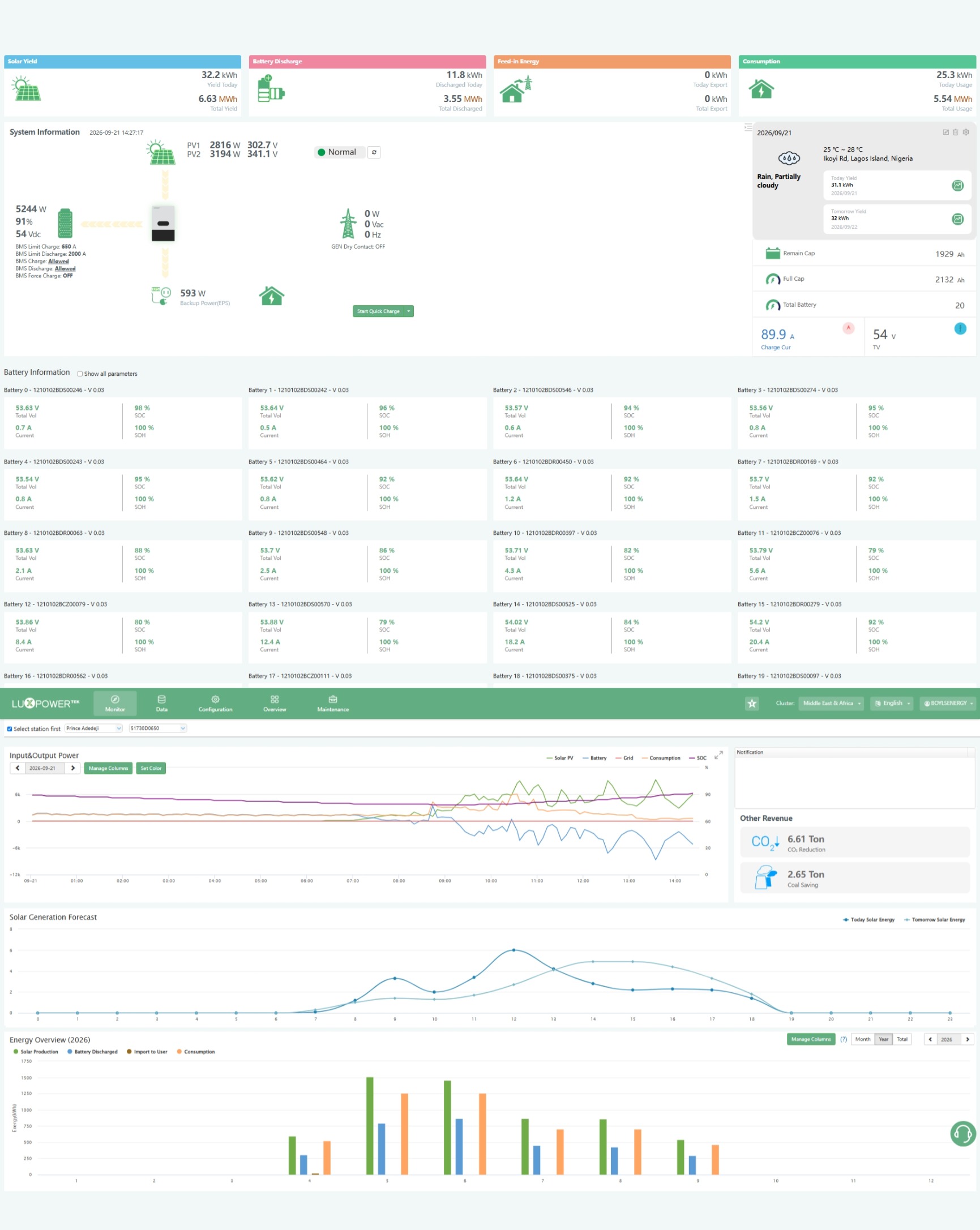
Installing solar panels is one thing. Knowing whether the system is actually doing its job is another. That is why this project includes remote monitoring.
The homeowner can see what his system is doing. BOYLS can also monitor it remotely. He can see:
Solar production. Home consumption. Battery activity.
And imported electricity. This gives the homeowner something very important. Proof.
He does not have to wonder if his system is working. He can see it.
WHAT THE MONITORING SHOWED
 VIEW ORIGINAL MONITORING SCREENSHOT ↗
On 21 September 2026, the monitoring dashboard showed:
32.2 kWh
Solar energy produced that day.
25.3 kWh
Energy used by the home that day.
0 W
Grid input at the moment the screenshot was taken. The dashboard also showed about:
6.63 MWh
Total solar energy produced to date.
5.54 MWh
Total recorded household consumption to date. The longer-term monitoring view also showed very little imported electricity compared with the energy supplied by solar and batteries.
We want to be clear. A reading of 0 W at one moment does not mean the home will never use outside electricity again. We do not make that promise.
What the data does show is that this homeowner has greatly reduced his dependence on external electricity. And that was the goal from the beginning.
This is energy independence you can actually see.
AND WHAT ABOUT THE MONEY?
The homeowner reports that he is now saving more than ₦2 million each month in electricity-related estate expenses.
That is his reported experience. It is not an independently audited savings figure, so we do not present it as a guarantee for another home. Every home is different.
But the result is still important. Before the project, a large amount of money left the homeowner's pocket every month to buy electricity. Today, he owns much of the equipment producing and storing electricity for his home.
And the change is not only about money. His family has more comfort. His wife can work from home with more confidence.
The home can support its lifestyle better. He worries less about NEPA. He depends less on the estate generator.
And he can see his system's performance from the monitoring platform.
HE WAS ALSO WORRIED ABOUT WHAT HAPPENS AFTER INSTALLATION
The homeowner's concern was not only: “How much will this cost?” He also wanted to know:
“Will you still be there after I pay?” That is a fair question. He wanted reliable equipment.
He wanted support. He wanted monitoring. And he wanted a company he could reach if something went wrong.
BOYLS was not the cheapest quotation he received. But the homeowner was not looking for the cheapest collection of equipment. He wanted a system designed around his real needs.
Today, he is not only using the system. He is also referring BOYLS to other people. The relationship started with a referral.
Now the customer is referring others. For us, that says a lot.
HOW MUCH DID THIS SYSTEM COST?
Across the two phases, this Parkview Estate homeowner invested about:
₦25 MILLION – ₦30 MILLION
That is a serious investment. But there is something you must understand. You may not need a ₦25 million system.
This system was built for this homeowner. His energy use. His AC use.
His family. His lifestyle. And the level of independence he wanted.
Your home may need less. It may need more. It may need a completely different design.
That is why we do not believe every customer should be sold the same “solar package.” Your neighbour's system was designed for your neighbour.
Your own home needs its own answer.
BEFORE YOU ASK FOR A SOLAR QUOTE, ASK A BETTER QUESTION
Instead of starting with: “How much is a 10 kVA system?” Start with:
“How much electricity does my home actually use?”
Because imagine spending ₦10 million, ₦15 million or ₦20 million… …and later discovering that the system cannot power the things that matter most to you. That is painful.
Now imagine buying more batteries and panels than you really need. That is also wasteful. The goal should not be to buy the biggest system.
The goal should be to buy the right system. And that starts with data.
BEFORE YOU SPEND MILLIONS ON SOLAR, SPEND ONE MONTH UNDERSTANDING YOUR HOME
That is why BOYLS offers a: PAID RESIDENTIAL ENERGY AUDIT
₦250,000
One month of energy monitoring We monitor how your home actually uses electricity. That gives us better information before we start talking about:
Inverter size. Battery capacity. Solar panels.
AC use. Night-time power. And the level of energy independence you want.
This Parkview Estate project did not begin with 30 solar panels. It did not begin with 20 batteries. It did not begin with a ₦25–₦30 million investment.
It began with data.
And your home should start the same way.
READY TO STOP MANAGING ELECTRICITY?
If you are tired of high electricity costs… If your current inverter does not power the things you actually want… If you want to reduce generator or NEPA dependence…
Or if you simply want to know what the right system for your home will cost… Start with your home's real energy data.
BOOK YOUR RESIDENTIAL ENERGY AUDIT
Investment: ₦250,000 Monitoring period: One month
Reliable power should be engineered, not guessed.
BOYLS Engineering Services Limited Stop managing electricity. Start living normally. The darkness ends here.