For years, most Nigerian businesses treated power as a backup problem.
When the grid failed, you switched to a generator, managed fuel, crossed your fingers, and kept work moving.
That approach made sense for a while. But it also kept many businesses operating in the dark, not just during outages, but also in their understanding of their own energy use.
That is why more companies are moving from backup power to energy visibility.
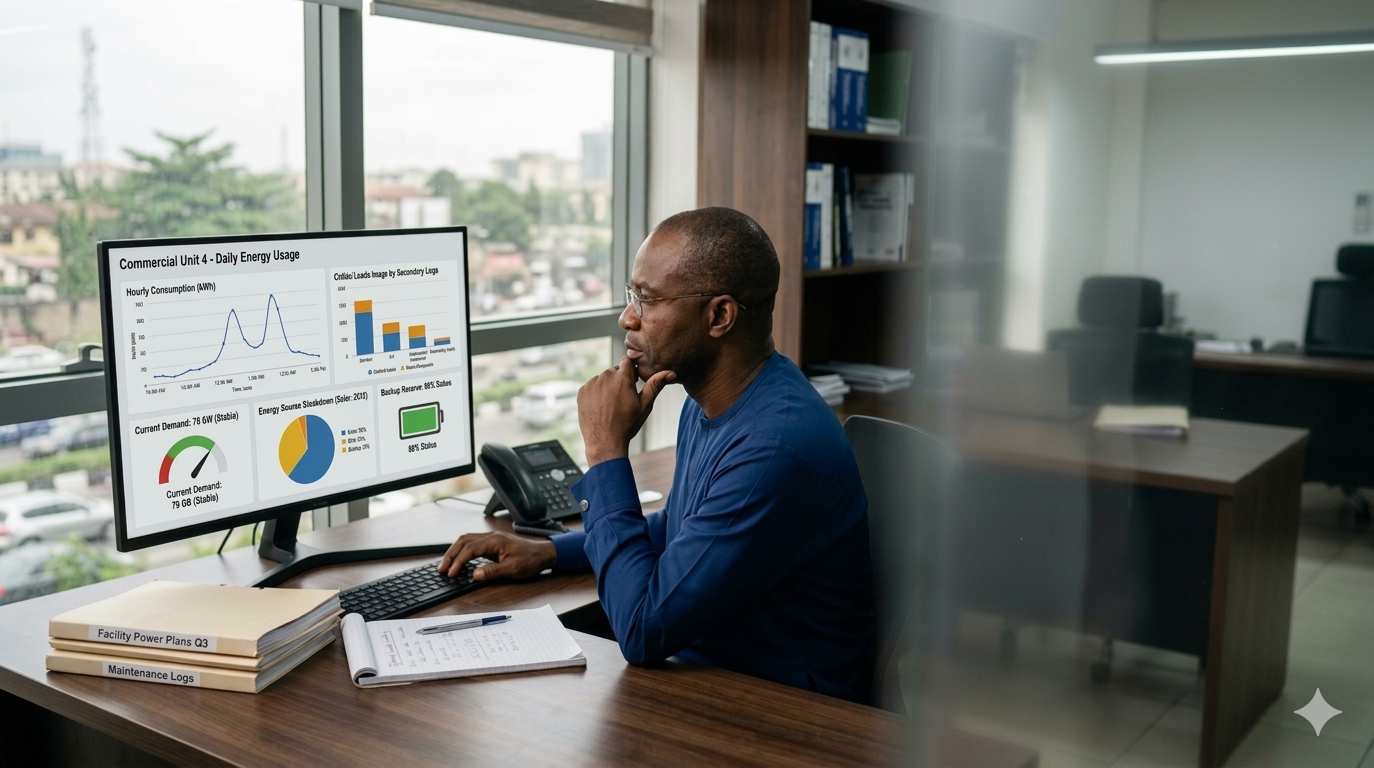
Energy visibility simply means being able to see what is happening in your power system: how much energy you use, when demand spikes, which equipment is driving costs, how often your generator is carrying the load, and whether your solar, inverter, or battery setup is actually performing the way it should.
It is a shift from reacting to outages to managing energy as a measurable business asset.
And honestly, Nigerian businesses have good reason to make that shift now. According to IFC’s 2025 Nigeria Country Private Sector Diagnostic, private firms in Nigeria endure power outages averaging eight hours per day.
The same report notes that unreliable electricity remains a major drag on productivity and competitiveness.
At the same time, the economics of “just manage it somehow” are getting harder to defend. NERC’s 2025 tariff orders continue Nigeria’s transition toward more cost-reflective electricity pricing, which means energy decisions matter more than ever for operating cost control.
And even with ongoing meter deployment, the metering gap is still significant: NERC’s Q3 2025 report shows 228,614 meters were installed in that quarter alone, yet the broader market still faces a large visibility problem because many customers remain under-metered or are only now entering better tracking frameworks.
So the conversation has changed. Business owners are no longer asking only, “How do I keep the lights on?” They are asking smarter questions: “What is my actual load?” “Why is my diesel bill rising?” “Which part of my operation should be on solar and battery backup?” “Where am I losing money without realizing it?”
That is the real story behind this transition. Nigerian businesses are not abandoning backup power because reliability no longer matters.
They are moving beyond backup power because reliability without visibility still leaves too much to guesswork. And when energy is this expensive, this unpredictable, and this critical to daily operations, guesswork is no longer good enough.
What Energy Visibility Actually Means for a Nigerian Business
In plain English, energy visibility means your business is no longer operating blind.
It means you can see what is consuming power, when that consumption is happening, how your backup systems are performing, and where waste is creeping in.
It is not the same as simply “having solar,” “having an inverter,” or “having a generator.” Those are assets.
Energy Visibility is what helps you manage those assets intelligently.
For a Nigerian business, energy visibility can include:
- real-time or near-real-time monitoring
- knowing which loads consume the most power
- battery performance tracking
- Solar production monitoring
- generator runtime tracking
- usage patterns by time of day
- clearer separation between critical and non-critical loads
That kind of visibility matters because it changes the quality of your decisions.
When you can see how energy behaves inside your business, you stop relying on assumptions.
You stop treating every outage the same way. You stop guessing what size of system you need, or whether your battery performance is “normal,” or whether your generator is carrying loads it should never have been covering in the first place.
In other words, visibility turns power from a recurring headache into something you can actually manage.
Why Backup Power Alone Is No Longer Enough
The old model was simple.
The outage happens.
You switch to a generator or an inverter.
You refill fuel.
You repeat the cycle.
For a long time, that felt like resilience. And to be fair, backup power is still essential for many businesses.
But backup power alone does not answer the bigger operational questions.
It does not tell you why fuel costs keep rising.
It does not tell you whether your equipment mix has changed your load profile.
It does not tell you whether your battery bank is being used efficiently.
It does not tell you which department, system, or process is quietly driving up your operating expenses.
That is why so many businesses that once thought backup was the solution are discovering that it was really the beginning of a bigger power management problem.
The wider Nigerian context makes this even more serious.
The World Bank has repeatedly highlighted that unreliable electricity raises business costs and weakens competitiveness, while self-generation fills the gap at a price.
In one 2025 World Bank document, the bank notes that much of the current demand is still being satisfied through gasoline and diesel generators, underscoring how deeply embedded self-generation remains in Nigeria’s operating reality.
So yes, backup power can keep the lights on.
But when you are spending heavily on diesel, servicing, maintenance, replacements, and emergency power decisions, “lights on” is no longer enough.
You need to know whether the whole system is actually working in your favor.
The Real Drivers Behind the Shift to Energy Visibility in Nigeria
This movement did not happen by accident. It is being driven by pressure from multiple directions.
1. Rising electricity and operating costs
Businesses can no longer afford to treat energy as a background expense.
Between tariff structures, supply inconsistency, and diesel price pressure, energy has become a strategic business issue.
The more volatile the environment feels, the more valuable the measurement becomes. If you cannot see where energy is going, you cannot manage it with confidence.
2. Generator dependence is expensive and exhausting
There is the obvious cost of fuel and servicing.
Then there is the less visible cost: noise, interruptions, maintenance stress, planning uncertainty, and the emotional drain of running critical operations in survival mode.
Business owners are tired of feeling like reliable power depends on constant vigilance, emergency refueling, and repeated compromises.
That fatigue is real. And it is one of the reasons energy visibility is becoming more attractive. Because visibility offers something generators alone do not: peace of mind through clarity.
3. Decision-makers want proof, not assumptions
Today’s business owners want better answers to practical questions:
- What is actually driving our consumption?
- What size solar system do we really need?
- Which loads should sit on battery backup?
- When is the generator truly necessary?
- Which part of the business is pushing up the bill?
Those are not “technical” questions in the abstract. They are budgeting questions. Growth questions. Risk questions.
And the only way to answer them properly is with better visibility.
4. Smarter technology is becoming more accessible
Monitoring apps, smart inverters, remote performance tracking, and more intelligent system design are changing expectations.
Businesses no longer see power systems as boxes that sit quietly in a corner until something fails.
They increasingly expect to observe performance, understand trends, and make adjustments over time.
That shift in expectations is important. It means energy systems are no longer just installed. They are increasingly expected to be measurable.
From Generator Mentality to Energy Visibility Strategy
There is a real mindset difference between the old approach and the new one.
Backup power mindset
This mindset is reactive.
It is focused on keeping the lights on, getting through the outage, and handling the next issue when it arrives.
There is often little tracking, very little load data, and limited long-term planning. Most decisions are driven by urgency.
Energy visibility mindset
This mindset is proactive.
It is focused on uptime, cost control, planning, and system performance. It tracks load behavior. It supports future expansion. It helps justify investments in solar, batteries, efficiency upgrades, and better operating habits.
And once a business can see its energy habits clearly, better decisions stop feeling risky.
That is one of the quiet advantages of visibility. It reduces uncertainty. It gives owners and managers a stronger basis for action.
Instead of asking, “Will this investment work?” they can start asking, “What does our actual usage tell us is the right next move?”
How Energy Visibility Helps Businesses Save Money
Energy visibility does not magically cut bills overnight.
What it does is help businesses stop paying for avoidable inefficiency.
That can happen in several ways.
First, visibility helps identify energy waste. You may find that certain loads are running outside necessary hours, or that systems are consuming more than expected because of poor scheduling, weak habits, or unnoticed faults.
Second, it helps reduce unnecessary generator runtime. When you understand which loads are critical and when they are needed, you can avoid using the generator as the first instinct for every interruption.
Third, it improves battery usage. A business that tracks battery performance can see whether storage is being used strategically or simply being stressed without a clear backup plan.
Fourth, it supports proper solar sizing. Many businesses overspend or under-design because they never understood their true load in the first place. Visibility makes right-sizing more realistic.
Fifth, it helps time-consuming loads more intelligently. Once you understand your daily usage patterns, you can shift or manage consumption more deliberately.
Sixth, it helps catch faults earlier. A performance issue that is visible early is usually cheaper to address than one that quietly drives up cost for months.
None of that is hype. It is simply what happens when guesswork is replaced with better information.
Why Solar Projects Work Better When Energy Visibility Comes First
This is one of the most important parts of the conversation.
Many businesses buy power systems before they understand their actual energy pattern. They know they are tired of outages.
They know fuel is painful. They know solar sounds like a smarter future. But they do not yet know their true load behavior, backup needs, or usage priorities.
That is how disappointment happens.
Systems get sized on assumptions. Battery expectations are unrealistic. Inverters are selected without enough context. ROI expectations become fuzzy.
Then, after installation, the business feels confused because the system is not solving the exact problem they thought it would.
That is why assessment-led design matters.
When visibility comes first, the system design becomes stronger:
- better load profiling
- better inverter sizing
- better battery sizing
- better ROI expectations
- fewer unpleasant surprises after installation
This is exactly why BOYLS’ approach makes sense. An energy audit first.
A custom-designed solution next. Monitoring and after-sales support are built into the thinking, not treated as an optional extra.
It is calm, engineer-led guidance designed to reduce uncertainty before money is committed.
That is how reliable power becomes more than hardware. It becomes a well-planned business decision.
5 Signs Your Business Needs Energy Visibility Now
Some businesses already know they have a visibility problem. Others only feel the symptoms.
Here are five signs it is time to take the issue seriously.
1. Your generator runs more often than you expected
If generator use has quietly become normal, that is a signal. Either the backup burden is too high, the load is not being managed well, or your system priorities are unclear.
2. Your electricity bill keeps rising, but you do not know why
When monthly costs increase without a clear explanation, visibility is usually missing somewhere.
3. Your inverter or battery performance feels inconsistent
If backup duration seems unpredictable, or performance no longer matches expectations, you need better tracking before you can make the right fix.
4. You are planning solar, but you do not know your true load
This is one of the clearest warning signs. Buying a new power solution without clear load data is a gamble.
5. Your business has grown, but your power setup has not evolved with it
More equipment, more operating hours, more staff, more processes. Growth changes energy demand. If your setup has not been reviewed, your system may no longer fit your reality.
5 Common Mistakes Businesses Make When Trying to Upgrade Their Power System
Many businesses lose money quietly when they try to improve their power setup without enough visibility.
Some of the most common mistakes include:
Sizing a system based on guesswork
This is probably the most expensive mistake. A system that looks fine on paper can disappoint badly if it was built on poor assumptions.
Buying cheap components without long-term planning
Low upfront cost can become high lifecycle cost when components are unreliable, poorly integrated, or harder to maintain.
Ignoring load audit data
Even when businesses have clues about usage, they sometimes rush past proper analysis. That usually leads to weaker decisions later.
Treating monitoring as optional
Monitoring is often seen as a “nice extra,” when in reality it is what helps a business protect performance and spot issues early.
Focusing only on installation cost, not lifecycle cost
The smarter question is not only, “How much does this cost to install?” It is also, “How well will this support our operations, reduce waste, and perform over time?”
These are the moments where businesses lose money quietly. Not always through dramatic failure, but through small design mistakes, poor visibility, and avoidable inefficiency that accumulates month after month.
Stop Letting Energy Costs Hide in Plain Sight
If your business is spending heavily on NEPA and diesel, but you still do not have a clear picture of where the waste is coming from, it may be time for a better approach.
At BOYLS Energy, we help Nigerian businesses move beyond guesswork with energy audits and ongoing monitoring designed to uncover inefficiencies, reduce unnecessary spend, and improve operational control.
Whether you run a hotel, clinic, school, factory, supermarket, or large commercial property, our process helps you:
- Identify major energy leaks
- understand generator and diesel inefficiencies
- Detect unusual consumption patterns
- build a clearer path toward reliable, cost-controlled power
Your business should not depend on NEPA’s schedule — or on assumptions.
Let BOYLS help you see clearly, act confidently, and move closer to real energy independence.
FAQ
Question 1: What is energy visibility in a business?
Answer: Energy visibility means having a clear understanding of how electricity and fuel are used across a business. It helps owners identify waste, monitor usage patterns, and make better decisions about cost control and efficiency.
Question 2: Why are Nigerian businesses moving from backup power to energy visibility?
Answer: Nigerian businesses are moving toward energy visibility because backup power alone does not reveal waste, inefficiency, or abnormal diesel consumption. Visibility helps businesses understand where energy is going and how to reduce avoidable costs.
Question 3: What does an energy audit for Nigerian businesses reveal?
Answer: An energy audit can reveal a business’s true energy baseline, major consuming loads, wasteful usage patterns, generator inefficiencies, diesel control gaps, and opportunities for cost savings.
Question 4: Which businesses benefit most from energy audits?
Answer: Hotels, hospitals, schools, manufacturing facilities, supermarkets, estates, and other businesses with high energy spend benefit most from energy audits because they often face both power reliability challenges and high diesel costs.
Question 5: Can energy monitoring help reduce generator and diesel costs?
Answer: Yes. Energy monitoring helps businesses track generator runtime, spot unusual energy use, maintain accountability, and reduce unnecessary diesel consumption over time.
Question 6: When should a business consider an energy audit?
Answer: A business should consider an energy audit when energy bills keep rising, diesel use is difficult to explain, generator costs are increasing, or there is no clear visibility into where waste is happening.