If you’ve ever been stuck in the middle of a blackout — maybe during a Zoom call, school assignment, client meeting,
Or even while your kids are trying to sleep, you already understand why portable power stations have become one of Nigeria’s fastest-growing energy solutions.
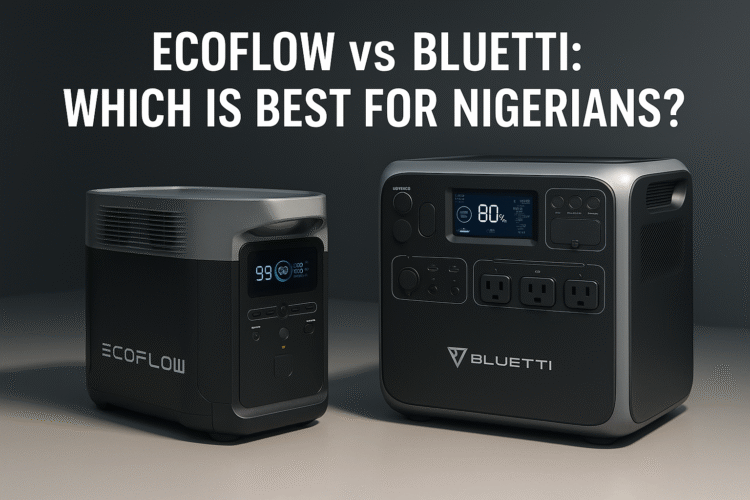
And like many Nigerians I speak with, you’ve probably asked the big question: “EcoFlow or BLUETTI — which one should I buy?”
Both brands are global leaders. Both use LiFePO4 solar generator technology.
Both promise fast charging, long lifespan, and low running costs.
But the experience? The real-life performance in Nigerian heat, humidity, and PHCN unpredictability?
That’s where the difference begins to show.
Today, I’ll walk you through a clear, practical comparison — the kind of advice we give homeowners, SMEs, and landlords every week at BOYLS. No hype. Just what works.
EcoFlow vs BLUETTI — What Nigerians Actually Care About
After working with thousands of residential and commercial clients across Lagos, Abuja, Ibadan, and Port Harcourt, I’ve found that Nigerians care about five things when choosing a portable power station:
- Speed of charging (nobody wants 5–7 hours of downtime)
- Battery lifespan (especially LiFePO₄ longevity)
- Durability in hot climates
- True inverter capacity, not “marketing cap.acity”
- Ease of use and after-sales support
Let’s break it down properly.
Charging Speed — EcoFlow Leads With X-Boost Technology
EcoFlow is famous for X-Boost technology, which allows their power stations to pull extremely high input wattage and charge from 0–80% in under an hour. If you’re looking for a fast charging power station in Nigeria, EcoFlow usually takes the win.
Why It Matters in Nigeria
PHCN is unpredictable. You may get just 2–3 hours of light.
A power station that charges fully in those hours gives you real independence.
Quick Comparison
- EcoFlow DELTA 2 / DELTA 2 Max: 60–70 minutes to 80% (X-Boost)
- BLUETTI AC200MAX: ~2.5 hours
- BLUETTI EB series: 3–4 hours
Winner: EcoFlow
If fast charging is your priority, EcoFlow comfortably dominates this round.
Battery Lifespan — BLUETTI Takes the Advantage With 3,500+ Cycles
Both brands use LiFePO₄ batteries, but BLUETTI pushes the limits with extremely high cycle counts.
Cycle Life Comparison
- BLUETTI AC200MAX: ~3,500 cycles
- EcoFlow DELTA 2 Max battery life: ~3,000 cycles
- EcoFlow DELTA 2: ~3,000 cycles
What Does This Mean?
A cycle is one full charge and discharge.
3,500 cycles = ~10 years of daily use.
Winner: BLUETTI
For battery longevity alone, BLUETTI slightly edges out the competition.
Inverter Power — DELTA 2 vs BLUETTI AC200MAX
This is the comparison everybody asks for:
DELTA 2 vs BLUETTI AC200MAX.
EcoFlow DELTA 2
- 1,800W inverter
- 2,700W X-Boost output (temporary)
- 1,024Wh storage
- Expandable up to 3kWh
BLUETTI AC200MAX
- 2,200W continuous inverter (stronger)
- 4,800W surge
- 2,048Wh storage
- Expandable up to 8kWh+
Performance Verdict
If you want to run multiple appliances or business equipment at once, AC200MAX is the stronger performer.
If you want speed, convenience, and a more compact setup, DELTA 2 wins.
Winner: Depends on your needs
- For homes: DELTA 2
- For small businesses: AC200MAX
- For hybrid use: DELTA 2 Max
Solar Charging — Close Match, But EcoFlow Is More Efficient
EcoFlow’s MPPT solar controllers generally handle higher input wattage with more consistent conversion efficiency.
Solar Input Comparison
- EcoFlow DELTA 2 Max: Up to 1000W
- BLUETTI AC200MAX: Up to 900W
In full Nigerian sun, the difference becomes noticeable.
Winner: EcoFlow
Especially for homes with limited solar panel space.
Certification & Safety — The Tie-Breaker for Nigerian Buyers
This is a crucial point most buyers overlook:
A certified portable power station in Nigeria must offer:
- Overload protection
- Pure sine wave output
- Short-circuit protection
- Battery temperature management
- Verified LiFePO₄ cells
Both brands meet international certifications (UL, CE, FCC).
However, EcoFlow’s thermal management tends to perform slightly better in high-heat environments like Lagos and Port Harcourt.
Winner: EcoFlow (slightly)
Real-Life Experience in Nigeria — What We’ve Seen in the Field
Across our client interactions — homeowners, medical offices, schools, salons, SMEs — one pattern keeps showing up:
EcoFlow users mention:
- How fast the units charge
- How simple the app is
- How seamless X-Boost handles heavy loads
BLUETTI users mention:
- Long battery life
- Excellent durability
- Strong performance for AC-heavy loads
This aligns with Nigeria’s two major client groups:
Homeowners
Prefer reliability, silence, and convenience
Commercial users (schools, clinics, offices)
Prefer high capacity and long-term ROI
BOYLS Recommendation — Which Should You Choose?
We follow one principle:
Recommend what truly works for your lifestyle, not what is popular.
Choose EcoFlow if you want:
- Fast charging
- Lightweight design
- Quick solar top-up
- Excellent app integration
- Good performance with small to mid-size home appliances
Choose BLUETTI if you want:
- Maximum inverter power
- Longest battery lifespan
- A portable system capable of running business equipment
- High-capacity expansion for future use
For balanced performance:
EcoFlow DELTA 2 Max gives the sweet spot between speed, lifespan, and capacity.
Conclusion
Choosing between EcoFlow vs BLUETTI doesn’t have to be confusing. Both are powerful. Both are reliable. And both deliver real independence in a country where PHCN uncertainty disrupts everything — from school assignments to business operations.
But the right choice comes down to your lifestyle:
- EcoFlow = speed + convenience + better solar efficiency
- BLUETTI = long lifespan + raw inverter power
Whichever you choose, you’re investing in peace, comfort, and control — the same transformation homeowners across Nigeria told us they experienced when they switched to clean, quiet power.