
It is 7 pm.
The children still have homework to finish, the fridge is running, and you would like to watch television without hearing the generator outside.
You start looking for a solar system. Before long, you have three quotations, all described as “5kVA”—with different prices and very different promises.
Which one will actually give your family the comfort you are paying for?
A 5kVA system can be a useful home-power solution, but its inverter rating tells only part of the story.
Battery capacity, solar-panel capacity, and your household’s consumption determine what the complete system can deliver.
Here is how to make sense of the price and the performance.
How much is a 5kVA solar system in Nigeria?
There is no single price for every 5kVA solar system. The packages below show why.
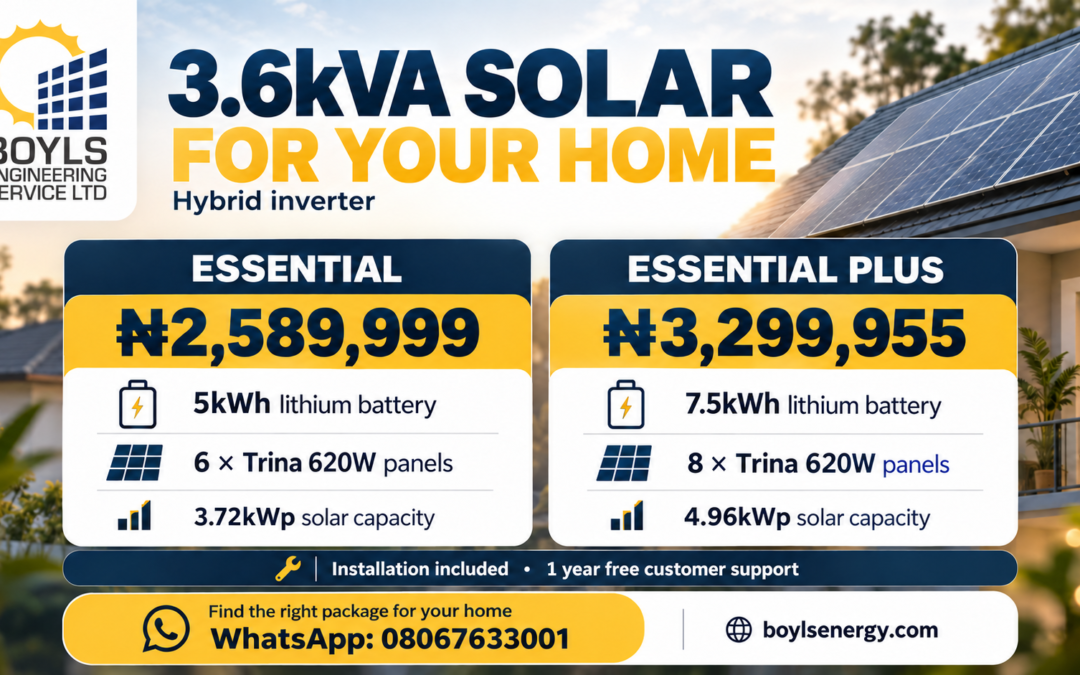
BOYLS’ current package is ₦5,000,000, including a 5kVA/5,000W hybrid inverter, a 15kWh lithium battery, ten units of 620W solar panels, installation, and installation kits.
For context, here are two other advertised packages alongside the BOYLS offer:
| Package | Price | Battery provision | Total solar-panel capacity | Installation |
| NovelSolar 5kVA package | ₦3,000,000 | Four 230Ah tubular batteries | 6 × 430W = 2.58kWp | Listed among the package components; confirm scope |
| Brave Power Felicity 5kVA package | ₦3,600,000 | 10kWh lithium battery | 6 × 600W = 3.6kWp | Included within Lagos, according to the listing |
| BOYLS 5kVA/5,000W package | ₦5,000,000 | 15kWh lithium battery | 10 × 620W panels = 6.2kWp | Installation and kits included |
Sources: NovelSolar and Brave Power. BOYLS specifications and price were supplied directly by BOYLS for this article.
These are three differently configured offers, not a national price range or a like-for-like quality comparison.
The BOYLS configuration has 50% more nominal battery capacity than the listed 10kWh package, alongside a larger rated solar array.
That helps explain the difference in price. It does not, by itself, prove a particular backup duration or daily electricity yield.
For broader budgeting guidance, read our Solar Installation Cost in Nigeria: Complete Home Price Guide.
What does “5kVA” actually tell you?
Think of the system as three parts doing three different jobs:
| Part | What you need to know |
| Inverter | How much equipment it can power at the same time |
| Battery | How much energy is available when you need stored power |
| Solar panels | How much generating capacity is available to supply daytime loads and recharge the battery |
The inverter’s kVA rating is its apparent-power rating. Its continuous output in watts must also be checked.
For example, Victron specifies its MultiPlus-II 48/5000/70-50 at 5,000VA and 4,000W continuous output at 25°C.
That is a specification for that particular model, not a rule that every 5kVA inverter produces 4,000W. Manufacturer specifications.
The BOYLS package described here uses a 5kVA hybrid inverter specified by BOYLS at 5,000W.
The exact model and operating limits should appear in the written quotation.
Also note the units: a 15kWh battery stores energy. This differs from a 15kW power rating.
Battery storage capacity alone does not tell you its maximum discharge power.
What can a 5kVA solar system power in a home?
A suitable 5kVA design can power lighting, fans, television, internet equipment, laptops, and refrigeration. The important question is what runs together.
Consider this illustrative evening load:
| Appliance | Assumed running power | Total |
| 10 LED lights | 10W each | 100W |
| 4 fans | 60W each | 240W |
| 1 television | 100W | 100W |
| 1 refrigerator, compressor running | 150W | 150W |
| 1 freezer, compressor running | 200W | 200W |
| 2 laptops | 65W each | 130W |
| 1 router | 15W | 15W |
| 3 phones charging | 10W each | 30W |
| Combined running load | 965W |
These are assumed values for explaining the calculation. They are not measurements from a customer’s home or guaranteed ratings for your appliances.
At 965W, this combination is below the BOYLS inverter’s stated 5,000W rating on running watts.
The design must still accommodate starting demand, apparent power, and the battery’s discharge limits.
Fridges and freezers also cycle on and off. Their consumption over a whole night will differ from the snapshot above.
Appliance labels provide a starting point; measurements help establish actual energy use. Virginia Cooperative Extension’s appliance-energy guide.
Can it run an air conditioner?
It can, where the AC’s power requirements and the other connected loads fit the system’s limits.
Keeping it running until morning is a separate sizing question.
Suppose your AC draws 1,000W at a particular moment. Added to the example above, that gives:
965W + 1,000W = 1,965W.
Now consider overnight energy. If an AC averages 800W for eight hours, it uses:
0.8kW × 8 hours = 6.4kWh.
If the rest of the house averages 400W over those eight hours, it uses another 3.2kWh. Together, that is 9.6kWh delivered to the appliances.
The 800W figure is an assumption, not a standard consumption figure for a 1HP or 1.5HP AC. Use the exact model and measured operation when sizing.
This is where an energy audit becomes useful. It connects “I want to sleep with the AC on” to the amount of battery storage your home actually needs.
How long could a 15kWh battery last?
A battery’s nominal capacity is not the same as the energy ultimately delivered to your appliances.
For this illustration, assume the battery is fully charged, 90% of its capacity is available for discharge, and 90% of that energy reaches the appliances after conversion losses.
That gives:
15kWh × 90% × 90% = 12.15kWh of estimated delivered energy.
| Average household load | Calculated backup duration |
| 500W | About 24.3 hours |
| 1,000W | About 12.2 hours |
| 1,500W | About 8.1 hours |
| 2,000W | About 6.1 hours |
These are battery-only calculations, not guaranteed BOYLS runtimes.
They exclude incoming solar, grid, or generator power and do not separately model inverter idle consumption.
Actual results depend on the selected equipment, reserve settings, battery condition, temperature, and changing loads.
Under these assumptions, the 9.6kWh overnight AC-and-household example would fit within the 12.15kWh allowance.
Your home may have a different demand.
The practical lesson is simple: the same battery can last through the night in one household and run down much earlier in another.
Why does the BOYLS package include ten 620W panels?
Ten 620W panels provide 6,200W, or 6.2kWp, of rated solar capacity.
That is the array’s rating under standard test conditions. It does not mean the panels produce 6.2kW from morning until evening.
The array has two jobs: supplying daytime consumption and providing energy for battery charging. If most of the day’s generation goes into household appliances, less remains for storage.
For an arithmetic example, assume four equivalent full-sun hours and a 75% overall yield factor:
6.2kWp × 4 hours × 75% = 18.6kWh.
This is an illustrative daily-energy estimate, not a Lagos weather statistic or a forecast for your roof.
It is before any additional battery-storage losses that apply to energy routed through the battery.
A site-specific design must consider shading, roof orientation, weather, equipment losses, and daytime demand.
Cloud cover can reduce solar output, so the design also needs a plan for periods when generation is insufficient. US Department of Energy: Solar Energy and Storage Basics.
The 6.2kWp array does not turn the inverter into a 6.2kW inverter. Its solar-input voltage, current, and permitted array size must be checked against the exact panel configuration.
What needs more careful planning?
Kettles, irons, water heaters, pumps, microwaves and additional ACs can quickly change the load.
Using assumed appliance ratings, the 965W household example plus a 2,000W kettle, a 1,500W iron and a 1,000W AC totals 5,465W. That exceeds the BOYLS package’s stated 5,000W output.
Some appliances may therefore need to run at different times. Others may justify a larger system.
Be clear about this before installation.
If your goal is to use several ACs and high-demand appliances together, the design should reflect that preference.
The 5kVA home solar package: ₦5,000,000
For homeowners considering this configuration, our complete package includes:
| Item | Included specification |
| Hybrid inverter | 5kVA / 5,000W |
| Lithium battery | 15kWh nominal storage |
| Solar panels | 10 × 620W Trina panels |
| Total rated solar capacity | 6.2kWp |
| Installation | Included |
| Installation kits and accessories | Included; itemised scope in the written quotation |
| Delivery | Free delivery, with location coverage confirmed in the quotation |
| Customer support | One year of free customer support |
| Total package price | ₦5,000,000 |
The offer combines the stated inverter output with storage for backup and a solar array for daytime supply and charging.
Its suitability depends on your load, roof, and required operating hours.
Ask for the written quotation to confirm the equipment models, installation scope, delivery coverage, applicable tax treatment, and component-by-component warranty terms.
Ask BOYLS whether this ₦5 million package suits your home.
Before you accept any solar quotation
Make sure you can answer these five questions:
- What will run together? Get a load schedule that matches your household.
- How many backup hours are being estimated, and at what average load? A runtime without a load assumption is incomplete.
- Can the panels supply daytime demand and recharge the battery? Ask for a site-based energy estimate.
- What happens during poor weather? Understand the reserve and backup arrangements.
- What exactly am I paying for? Check equipment models, installation materials, protection, warranty responsibilities, and support.
A quotation should help you understand the system you are buying, including its limits.
Frequently asked questions
Is 5kVA enough for a three-bedroom house?
It may be, but bedroom count does not determine electricity demand. The appliances, simultaneous usage, and required backup duration matter more.
Can a 5kVA system power a fridge and freezer together?
Yes, if their combined running and starting demands, along with the other loads, fit the inverter and battery capabilities.
Will the BOYLS package provide 24-hour power?
That cannot be established from the component list alone. Continuous supply depends on daily consumption, solar generation, battery storage, and any grid or generator contribution.
Can I add more batteries or panels later?
Possibly. Expansion depends on the inverter’s input limits, battery compatibility, manufacturer requirements, and available installation space. Discuss it before choosing the equipment.
Before you spend ₦5 million, know what your home needs
The worry is understandable: “What if I spend all this money and my family still has to manage power?”
You deserve a clear answer before making that investment.
Start with the life you want at home: the appliances you want to use, the hours you need them, and how much reliance on the grid or generator you are comfortable with. Then check those expectations against your actual consumption.
The ₦5 million BOYLS package may be the right fit. Your household may also need a different design. An Energy Audit helps establish that before you commit to equipment.
You should know what will stay on, for how long, and under what conditions—before installation day.
Find out what your home actually needs. Start your BOYLS Energy Audit.
Speak with BOYLS on WhatsApp or call +234 806 763 3001.